

The Rise Of Machine-Driven Economic Activity
How autonomous software could reshape digital commerce, payment infrastructure, and the role of programmable money
The Crypto Advisor is your trusted resource for navigating the world of cryptocurrency. Each week, we deliver a clear and concise update on the latest developments in crypto, straight to your inbox. This is more than just a newsletter; it’s an essential resource for forward-thinking advisors focused on maintaining a competitive edge. We’re excited to support your journey in adapting to and thriving in the new age of financial services.

The Rise Of Machine-Driven Economic Activity
Recently, Coinbase CEO Brian Armstrong made a simple but striking observation:
“Very soon there are going to be more AI agents than humans making transactions. They can’t open a bank account, but they can own a crypto wallet.”
At first glance, this sounds closer to science fiction than financial analysis. Yet beneath the futuristic framing lies a structural question all investors may eventually need to confront: what happens when economic participation is no longer limited to humans?
To understand why this idea is receiving attention, it is useful to clarify what is meant by an “AI agent.” In most cases, the term does not refer to fully autonomous intelligence, but to software capable of performing defined tasks with a degree of independence. These systems can gather information, execute workflows, interact with digital services, and increasingly coordinate with other software. While still early, the direction suggests a gradual shift toward more active participation in digital economic activity.
Today, most AI systems function primarily as productivity tools, assisting with research, coding, analysis, and operational automation. Over time, the boundary between assistance and execution may blur. Rather than simply generating outputs, these systems could begin purchasing access to data, paying for computing resources, interacting with APIs, and completing transactional workflows on behalf of individuals or institutions.
This is where the discussion moves from technology to financial infrastructure.
Modern financial systems were designed around identifiable participants - individuals, corporations, and regulated intermediaries - with identity verification and compliance acting as foundational safeguards. This architecture functions effectively when economic activity is mediated by accountable entities. It becomes less intuitive when the participant is software expected to transact autonomously and continuously across jurisdictions.
Software cannot independently open a bank account or complete the compliance processes that underpin most transaction systems. It can, however, hold a cryptographic key and participate in value transfer without the institutional mediation assumed by existing infrastructure.
That dynamic is beginning to shape how parts of the technology and financial sectors are thinking about future payment systems. A crypto wallet provides software with a mechanism to store and transfer value over internet-native networks. When funded with stablecoins - digital representations of fiat currencies - the model begins to resemble a programmable extension of existing monetary systems rather than a separate ecosystem.
Stablecoins introduce characteristics aligned with emerging digital service markets: continuous availability, global settlement, and the ability to process transactions at an extremely small scale without the friction associated with traditional payment networks. As pricing across software, data, and compute shifts toward usage-based models, these features become increasingly relevant.
Put differently, if the internet evolves into a network where software increasingly pays software, payment infrastructure will need to evolve alongside it.
To make this more tangible, consider a simple example.
Imagine a portfolio manager preparing for a meeting on emerging market infrastructure. Rather than manually sourcing research, datasets, and analytical tools, they rely on a digital assistant configured within predefined parameters. Overnight, that system identifies relevant data providers offering satellite-derived trade indicators. It purchases access on a usage basis, pays a separate provider for short-term computing capacity, and compiles a summary before the workday begins.
Each step involves a financial transaction, but without the onboarding friction, subscription management, or cross-border settlement delays typical of traditional systems. Instead, the system draws from a wallet funded with stablecoins, settling small payments programmatically as tasks are completed. The process resembles a continuous extension of the research function rather than a discrete financial workflow.
From the user’s perspective, the shift feels incremental. The underlying change is less about artificial intelligence becoming autonomous in a science-fiction sense and more about software gradually assuming operational responsibilities already embedded in digital workflows.
However, this scenario also surfaces institutional constraints. Software systems do not currently possess legal authority, fiduciary responsibility, or regulatory recognition as economic actors. They cannot hold licenses, assume liability, or be supervised in the same way as individuals and institutions can. Any expansion of autonomous financial activity would therefore require adjustments to regulatory frameworks, governance models, and risk controls.
Such changes are likely to emerge incrementally, first within controlled environments such as enterprise systems, developer platforms, and permissioned marketplaces. These settings allow new transactional models to develop without immediately challenging broader financial stability.
It is also important to distinguish long-term structural potential from current levels of activity. Despite growing attention around AI agents conducting transactions online, the scale of real economic activity remains modest. One widely circulated estimate circulated by Bloomberg, suggested autonomous agents processed roughly $24 million in payments over a single month. A more detailed analysis from venture firm Andreessen Horowitz, however, indicates that the figure may be closer to $1.6 million once wash trading and circular flows are removed.
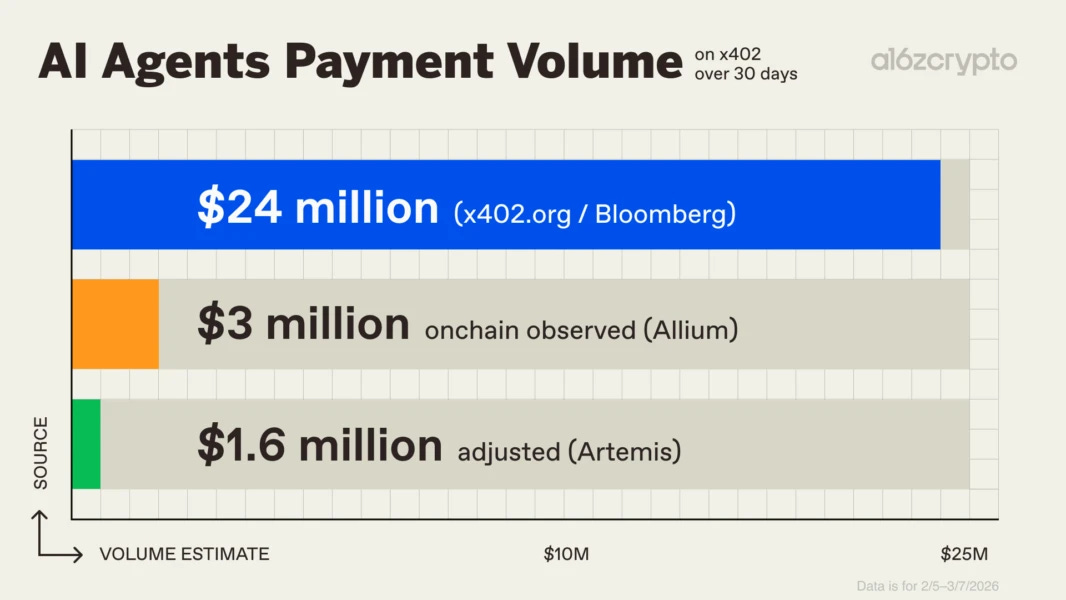
Most activity today is concentrated in narrow use cases such as developer tools, experimental compute markets, and early API-based service payments. The infrastructure is beginning to form, but the economic footprint remains limited.
This growth pattern may resemble prior technological transitions. Cloud computing, mobile payments, and electronic trading systems each developed within specialist environments long before their commercial significance was widely recognized. Early phases often appeared incremental relative to the systemic role these technologies later assumed.
At the same time, institutional investment in the underlying architecture continues to accelerate. Financial technology firms and digital asset platforms are exploring standards for machine-to-machine transactions, while major technology companies evaluate how autonomous systems may interact with digital marketplaces and service networks. In many cases, capital deployment is occurring ahead of clear revenue models, reflecting strategic positioning rather than immediate commercialization.
From a portfolio perspective, the relevance of this trend does not depend on near-term transaction volumes. It lies in the possibility that economic participation may gradually expand beyond human actors to include software operating within defined constraints. If such a transition unfolds over the coming decade, financial infrastructure supporting digital commerce could evolve in ways not yet fully incorporated into current market narratives.
This does not imply inevitability, nor does it eliminate regulatory, technological, or behavioral uncertainty. Adoption is likely to be uneven, shaped by policy decisions, institutional risk frameworks, and practical considerations around governance and accountability.
Yet the moment tens of millions of AI agents begin demanding internet-native money to transact with each other, owning the assets that power that economy may start to look far less like speculation - and far more like being early once again.

The SEC And CFTC Enter A Mutual Agreement On Crypto

The U.S. SEC and the CFTC have entered into a formal Memorandum of Understanding aimed at strengthening coordination on financial market oversight, including the regulation of crypto assets and the introduction of new digital asset products. The agreement reflects a broader effort to modernize regulatory frameworks and reduce longstanding jurisdictional friction between the two agencies, which has historically complicated compliance and slowed innovation.
According to the agencies, the MOU is designed “to support lawful innovation, uphold market integrity, and ensure investor and customer protection,” while also advancing federal policy efforts toward a more “fit-for-purpose regulatory framework” for crypto and other emerging technologies. SEC Chairman Paul Atkins noted that regulatory turf conflicts have often pushed market participants to operate in other jurisdictions, while CFTC Chairman Michael Selig emphasized that harmonizing oversight will be essential as financial markets continue to evolve.
Although the agreement is non-binding, it signals increasing alignment among key U.S. regulators as digital assets become more embedded within the broader financial system and policy discussions shift toward clearer coordination and product pathways.
The White House Mentioned Crypto in Its Cyber Strategy

Cryptocurrency received several references in the White House’s newly released cybersecurity strategy outlining President Donald Trump’s approach to strengthening U.S. defenses against evolving digital threats. While the document primarily focuses on modernizing federal cyber infrastructure and protecting critical systems, its inclusion of crypto and blockchain technologies signals that digital assets are increasingly being viewed as part of the broader technological stack underpinning financial and national security systems.
One section emphasizes the role of emerging technologies in maintaining U.S. competitiveness and security, stating that policymakers will support secure supply chains and protect user privacy “from design to deployment,” explicitly including the security of cryptocurrencies and blockchain technologies. The strategy also highlights the adoption of post-quantum cryptography and resilient digital infrastructure as key priorities.
“We will accelerate the modernization, defensibility, and resilience of federal information systems by implementing cybersecurity best practices, post-quantum cryptography, zero-trust architecture, and cloud transition.”
The inclusion of digital assets within national cybersecurity planning reflects their growing integration into core financial infrastructure, reinforcing the trajectory toward more formalized oversight, security standards, and institutional engagement.
Mastercard Expands Blockchain Push With Major Crypto Partner Program

Mastercard has introduced a new Crypto Partner Program that brings together more than 85 companies across the crypto, fintech, and banking sectors to explore how blockchain technology can integrate with the existing global payments system. The initiative includes major digital asset firms such as Binance, Circle, Ripple, Gemini, PayPal, and Paxos, and focuses on practical applications like cross-border transfers, business payments, and global payouts.
Rather than attempting to replace traditional financial infrastructure, the program aims to connect blockchain-based tools with the payment networks that already support everyday commerce. Mastercard’s global rails, which link banks, merchants, and consumers in more than 200 countries, are viewed as a key distribution layer for scaling on-chain financial activity.
The initiative builds on Mastercard’s broader push into digital assets, including crypto-linked payment cards, investments in blockchain startups, and compliance solutions designed for financial institutions. Similar moves by competitors such as Visa underscore a wider industry shift toward integrating digital assets into mainstream payment systems, though achieving interoperability, regulatory clarity, and technical standardization remains a complex and ongoing process.

How Might An Institution Hypothetically Pitch Ethereum?
This framework draws on recent commentary from the former Head of Crypto at BlackRock and offers a glimpse into how large institutions may explain Ethereum to traditional investors.
In that context, the conversation often begins with the size of the opportunity rather than the token itself. The focus is placed on the markets Ethereum is positioned to serve: stablecoins potentially expanding from hundreds of billions toward trillions, tokenized real-world assets following a similar trajectory, and the gradual emergence of institutional-grade decentralized finance. This mirrors traditional equity analysis, where the addressable market is evaluated first, and the asset’s role within that market is assessed second.
From there, attention shifts to Ether’s function within the system. In institutional frameworks, ETH is frequently described less as a speculative digital asset and more as a “trust commodity” securing a new financial settlement layer. As more value settles on-chain, the asset responsible for validating and securing those transactions becomes increasingly integral to the infrastructure itself. This framing translates Ethereum’s economic model into terms familiar to investors accustomed to evaluating payment networks, clearing systems, and financial rails.
Rather than emphasizing short-term price narratives or positioning Ethereum primarily relative to Bitcoin, the institutional lens tends to focus on intrinsic value derived from network activity, ecosystem growth, and long-term structural adoption.
Ultimately, the thesis rests on whether Ethereum can sustain its role as a primary settlement layer for digital finance. The network today hosts the largest concentration of stablecoins, leads in tokenized real-world assets, and continues to anchor a significant share of decentralized financial activity. If capital markets continue integrating blockchain-based infrastructure, the asset securing that system may increasingly be evaluated as core financial plumbing rather than a narrative-driven investment.
Disclaimer: The information provided by The Crypto Advisor is for educational and informational purposes only and does not constitute financial, investment, or legal advice. The Crypto Advisor is not a registered investment advisor, broker-dealer, or financial planner. Nothing in this email should be interpreted as a recommendation to buy, sell, or hold any financial instrument or investment. Always consult with a licensed financial professional before making any investment decisions.