

The Debasement Trade
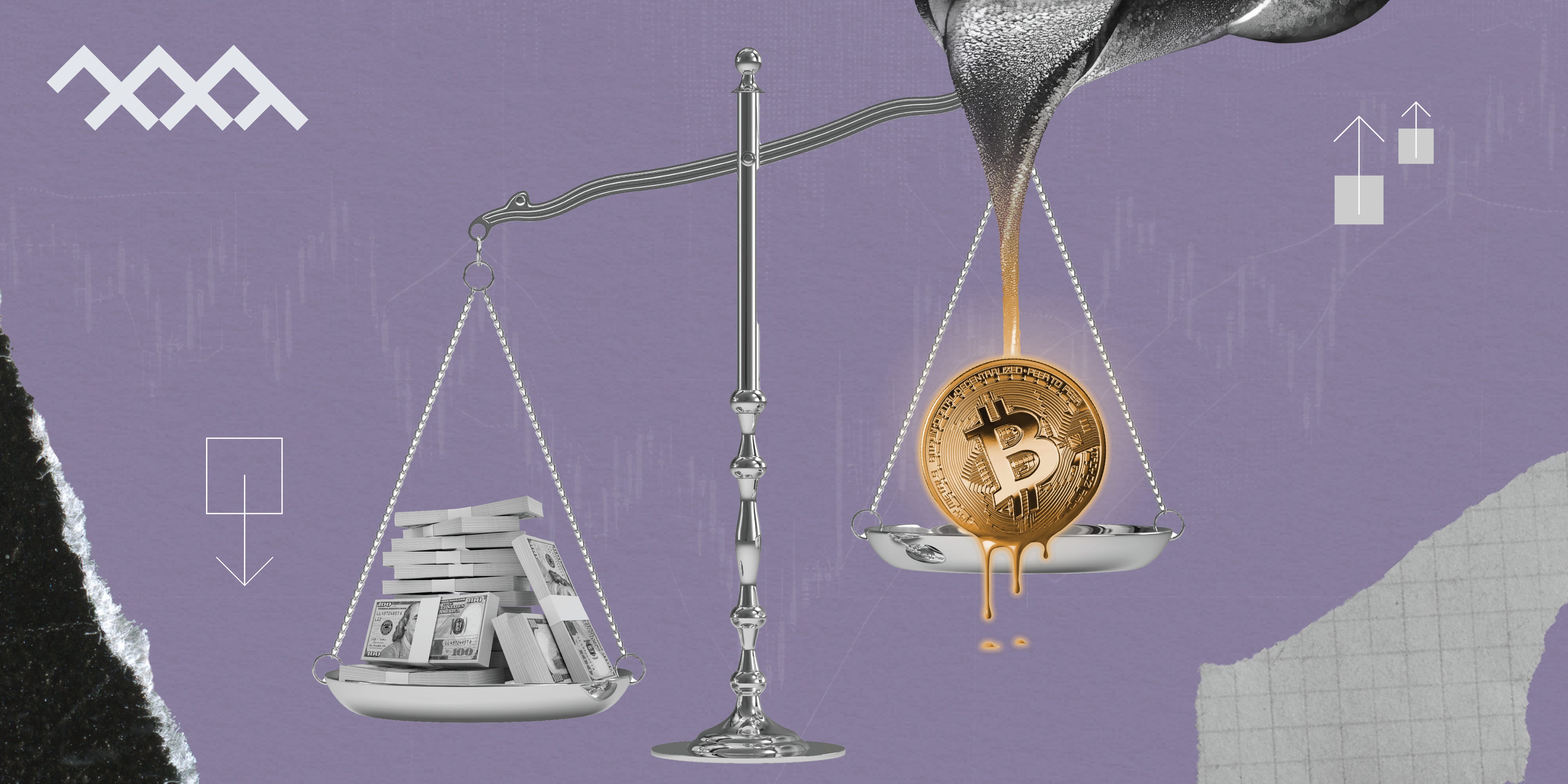
When currencies weaken, sound money doesn’t just hold value - it compounds it.
The Crypto Advisor is your trusted resource for navigating the world of cryptocurrency. Each week, we deliver a clear and concise update on the latest developments in crypto, straight to your inbox. This is more than just a newsletter; it’s an essential resource for forward-thinking advisors focused on maintaining a competitive edge. We’re excited to support your journey in adapting to and thriving in the new age of financial services.
The Debasement Trade
A Brief Preliminary Statement - A major crypto story unfolded late Friday - a flash crash that wiped out more than $19 billion (and counting) in leveraged positions. We broke down what happened in the Crypto Current segment below.
Our quick takeaway: this crash was mostly technical - a perfect storm amplified by the timing of the President’s announcement, insider positioning, and exchanges struggling to contain extreme volatility. We’ll keep monitoring the fallout and circle back if new details surface.
But for today, our focus shifts to something far more important - gold’s evolving relationship with Bitcoin. It’s a story we’ve been tracking for months, and one that carries real long-term weight. Last Friday’s chaos, by contrast, hit mainly high-leverage traders, not the broader market - and will likely fade into history as a brief but memorable footnote in crypto’s larger narrative.
The Debasement Trade - The Bigger Picture
One topic came up in just about every conversation this past calendar week - the debasement trade.
“Did you see gold break $4,100 an ounce?”
“Up more than 50% this year - it’s finally moving.”
“Bitcoin’s going to follow right behind it.”
“Clients are realizing cash is the most crowded trade of all.”
“When real yields collapse, the hard stuff rallies.”
We’ve noticed that not only have advisors caught on quickly, but their clients have too, adding even more pressure to respond thoughtfully. The conversation has gone viral, and that’s a double-edged sword. On one side, there’s genuine enlightenment - more investors are finally understanding the mechanics of monetary debasement and the role of hard assets. On the other hand, misinformation is spreading just as fast, and we want to do our part in helping separate signal from noise.
On that note, we are going to set the record straight.
We’ve found that the simplest - and most relatable - way to explain the debasement trade, and naturally connect it to Bitcoin, is as follows:
The debasement trade starts with a simple truth: when governments print, save, and spend beyond their means, the value of money quietly erodes. You don’t see it on a statement, but it shows up everywhere else - in groceries, housing, and asset prices. Every new dollar created dilutes the purchasing power of the ones already in circulation.
Gold and Bitcoin represent the opposite side of that equation. They aren’t claims on someone else’s liability - they’re assets that can’t be printed or diluted. In a world where the supply of money is expanding faster than the supply of value, owning scarce assets is no longer speculation. It’s preservation.
We’ve noticed that while a good percentage of clients are on board with our understanding of the broader debasement trade, many hesitate when the conversation turns to Bitcoin. Rather than immediately appealing to authority - citing what professionals from JPMorgan, Morgan Stanley, or Citadel are now saying - we prefer to start with our own explanation. It’s often more effective to ground the idea in first principles before referencing who else has arrived at the same conclusion.
In doing so, we like to start with a simple question: “What properties make gold valuable?” From there, the conversation tends to open up naturally. Thoughtful answers often highlight gold’s qualities as hard money - its durability, divisibility, fungibility, and scarcity. It can’t be created at will, it doesn’t corrode, and it’s recognized and exchangeable almost anywhere on Earth.
We then extend the discussion to one more property that often goes overlooked: censorship resistance. Gold is valuable not just because it’s rare, but because ownership isn’t dependent on anyone’s permission. It sits outside the financial system - no intermediary can freeze, print, or inflate it away.
That’s where Bitcoin enters the picture. It replicates those same monetary characteristics - scarcity, portability, divisibility, and resistance to debasement - but in digital form. Unlike gold, it moves globally at the speed of information, with verifiable supply and self-custody. To us, Bitcoin doesn’t replace gold; it modernizes it.
This is usually the moment when the figurative lightbulb turns on for skeptics and non-believers. And if it doesn’t - that’s perfectly fine. Bitcoin doesn’t belong in every portfolio, and we move on. But when it does click, it tends to open up a much larger conversation - one that goes far beyond short-term price movements.
At that point, the discussion shifts from “Is Bitcoin a trade?” to “What role does Bitcoin play in a world where monetary debasement unfolds not over months, but over decades?” It becomes less about speculation and more about long-term positioning - how to preserve purchasing power in an era where the very denominator of value, fiat currency, continues to erode.
Now that the wheels are turning, we can hit them with the facts:
Even the largest institutions are beginning to acknowledge what investors have been sensing for months - the debasement trade is back.
JPMorgan recently noted that gold’s surge “has gone well beyond the moves implied by dollar and real bond yield shifts,” adding that it likely reflects “the re-emergence of this debasement trade.” The bank also pointed out that gold’s steep rise has made Bitcoin comparatively more attractive, especially as the bitcoin-to-gold volatility ratio has fallen below 2.0 - a sign of growing maturity in the asset.
Morgan Stanley is taking a similar stance, classifying Bitcoin within its real assets framework and describing it as “a scarce asset akin to digital gold.”
And while Citadel didn’t reference Bitcoin directly, its leadership echoed the same theme, observing “substantial asset inflation away from the dollar” as investors look to “de-dollarize” and “de-risk their portfolios vis-à-vis U.S. sovereign risk.”
These comments haven’t come out of nowhere.
Gold’s price per ounce is up roughly 55% year-to-date - an astonishing move for an asset long regarded as “boring.” Bitcoin, by comparison, is up around 24%, which might appear modest at first glance. But that comparison misses the larger point: both assets are responding to the same underlying force - a global search for stores of value amid ongoing monetary debasement.
The gap between Bitcoin’s market cap and gold’s has never been wider in absolute terms. Gold’s total market capitalization now sits near $28 trillion, while Bitcoin’s is roughly $2.5 trillion - a nearly $25 trillion spread between the world’s dominant store of value and its emerging digital counterpart.
Now imagine even a fraction of that capital rotating into Bitcoin. If just $3 trillion were to move from gold into Bitcoin, the impact wouldn’t be linear. The market couldn’t simply absorb that liquidity at current levels. Bitcoin’s fixed supply and relatively shallow market depth mean each marginal dollar would need to clear at progressively higher prices - producing an exponential, not incremental, effect.
That’s the essence of the debasement trade in practice: a rotation from paper to hard assets, from the old store of value to the new one.
At some point, the market will stop debating whether Bitcoin can rival gold and start recognizing that it already has. When that moment arrives, the re-pricing won’t be gradual - it will be a recognition event, one that permanently cements Bitcoin’s role as the dominant store of value in the digital age.
It’s not a consensus view - far from it. But history shows that conviction matters most before it’s comfortable.
Whether that happens in five months, years, or fifteen is unknowable. What’s clear is that the forces driving both assets - structural deficits, fiscal expansion, and persistent inflation - aren’t going away anytime soon. For advisors, that makes the conversation less about timing and more about positioning: how to allocate, how much exposure to consider, and how to explain to clients that owning scarcity may be the most prudent hedge of all.
That’s the essence of the debasement trade: not chasing price, but owning permanence.

Should Advisors Be Concerned About Friday’s Flash Crash?

Our answer is no. Friday’s $19 billion crypto liquidation was dramatic, but it was largely a technical event, not a fundamental one. The cascade was triggered by high leverage, exchange inefficiencies, and the unfortunate timing of a major political announcement - not by a deterioration in market structure or investor demand. Retail investors and institutional participants were mostly unaffected; the damage was concentrated among overleveraged traders caught on decentralized and derivatives platforms. In short, this was a mechanical flush, not a macro warning sign.
From a broader perspective, nothing has changed in crypto’s long-term trajectory. Institutional adoption is still expanding, ETF inflows remain healthy, and regulatory clarity continues to improve. Advisors should view this episode as background noise in an otherwise constructive market environment. The fundamentals - growing infrastructure, broader participation, and Bitcoin’s emerging role as a modern store of value - remain firmly intact. Use this story as a reminder to your clients that leverage rarely makes sense in an already volatile asset class.
S&P Global Introduces the Digital Markets 50 Index: Bridging Crypto and Traditional Equities

S&P Global has announced plans to launch the S&P Digital Markets 50 Index, a groundbreaking benchmark that blends traditional equity exposure with direct cryptocurrency holdings. The index will include 35 publicly traded companies engaged in blockchain, digital-asset infrastructure, and financial-services innovation, along with 15 cryptocurrencies drawn from the firm’s existing broad digital-market index. Each constituent - stock or token - will be capped at no more than 5% of the total weight, and eligibility thresholds are set at $100 million for equities and $300 million for crypto assets, ensuring institutional-grade standards and liquidity.
The index will follow the same quarterly rebalancing and governance framework used across S&P’s traditional benchmarks, offering RIAs and professional investors a familiar structure through which to gain diversified exposure to the emerging digital-asset ecosystem.
Notably, S&P Global collaborated with Dinari, a firm specializing in tokenized U.S. securities, to develop a tradable token that will track the index’s performance - effectively creating a bridge between regulated financial products and blockchain-based access.
For fiduciaries, this marks a potential inflection point: the world’s leading index provider is formally integrating cryptoassets and crypto-linked equities under one institutional framework. It reflects the increasing demand for transparent, rules-based exposure to digital markets - without forcing investors to choose between “crypto” and “stocks.”
Luxembourg Becomes First Eurozone Nation to Add Bitcoin to Its Sovereign Wealth Fund

Luxembourg has made Eurozone history by becoming the first member state to allocate a portion of its sovereign wealth fund to Bitcoin. The country’s Intergenerational Sovereign Wealth Fund (FSIL), which manages roughly $730 million, has introduced a 1% position in Bitcoin ETFs - a small but symbolic allocation that reflects growing institutional acceptance of digital assets as part of a diversified portfolio.
Finance Minister Gilles Roth outlined the move during Luxembourg’s 2026 budget presentation, alongside a policy update expanding the fund’s investment mandate to allow up to 15% exposure in alternative assets such as private equity, real estate, and crypto. Treasury Director Bob Kieffer emphasized that while the allocation is conservative, it serves to “balance risk while signaling confidence in Bitcoin’s long-term potential.”
For RIAs, Luxembourg’s decision underscores a broader trend: nation-state-level diversification into Bitcoin is emerging as a legitimate component of sovereign and institutional strategy. Similar to how corporate treasuries began with small pilot allocations, this policy shift from a highly regulated EU financial hub could encourage other European funds and pension managers to begin their own due diligence on digital assets.

What Advisors Should Know About Stablecoins
Most advisors think of stablecoins as digital dollars - a fast, efficient way to move money on-chain. But in practice, they’re one of the most important trading instruments in crypto, serving as the market’s primary form of liquidity. Traders use stablecoins like USDC and USDT as their base currency - the pair against which nearly every crypto asset is priced. Instead of converting back to fiat, they move in and out of stablecoins to lock in profits, hedge volatility, or park cash between trades while staying fully within the crypto ecosystem.
Stablecoins also make it easy to transfer funds instantly between exchanges, trading accounts, and wallets, letting traders chase arbitrage opportunities or respond to market moves in real time. A trader can exit a position on Binance, send USDC to a DeFi wallet, and re-enter a trade on Coinbase within minutes - all without touching a bank. Many also use stablecoins as collateral or yield-bearing assets on lending platforms, turning idle liquidity into passive income.
For advisors, understanding this dynamic is key because it shows how stablecoins quietly anchor market liquidity and price stability across the entire digital asset space. They act as the connective tissue between centralized exchanges, DeFi protocols, and institutional trading desks - a dollar-based layer that keeps global crypto markets synchronized. As traditional finance experiments with tokenized funds and instant settlement rails, the same mechanics traders use today will likely underpin the next generation of financial infrastructure. In that sense, stablecoins aren’t just a crypto convenience - they’re a preview of how capital may move in traditional markets tomorrow.
Disclaimer: The information provided by The Crypto Advisor is for educational and informational purposes only and does not constitute financial, investment, or legal advice. The Crypto Advisor is not a registered investment advisor, broker-dealer, or financial planner. Nothing in this email should be interpreted as a recommendation to buy, sell, or hold any financial instrument or investment. Always consult with a licensed financial professional before making any investment decisions.